
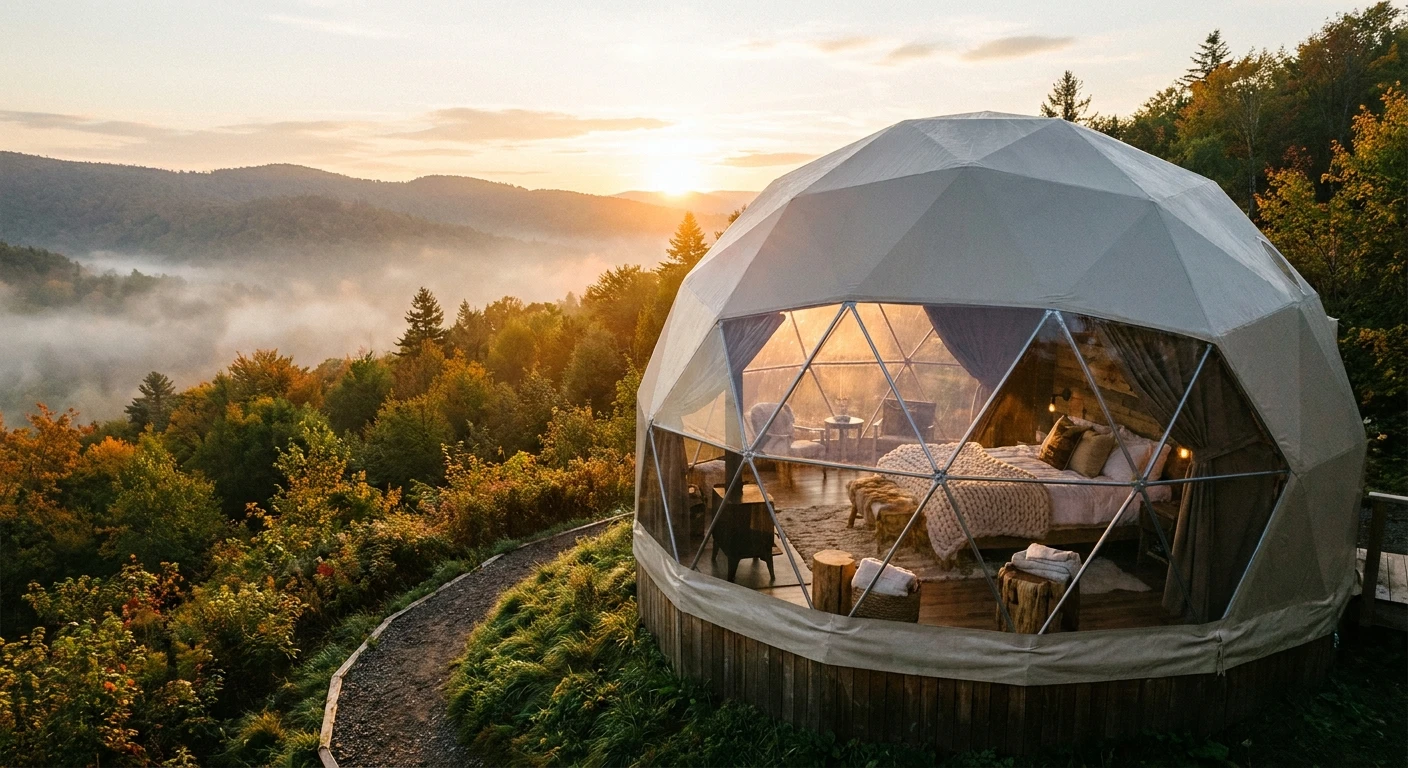
Why skyridge glamping is your next obsession
Let me tell you straight up, skyridge glamping is the only way you should be planning your next weekend escape. If you are tired of the constant notification pings, the concrete jungle, and the endless traffic, this is exactly what you need. Back in Ukraine, escaping to the Carpathian mountains usually meant roughing it in a cold, drafty wooden hut where you had to chop your own firewood just to survive the night. It was authentic, sure, but hardly relaxing. My perspective completely shifted when I experienced high-altitude luxury for the first time. You get all the breathtaking, untouched mountain views without sacrificing a hot shower or a cloud-like mattress. It is the perfect compromise for someone who loves the idea of the wilderness but absolutely refuses to sleep on the hard ground.
The beauty of this setup is how it forces you to slow down. You wake up, unzip your tent or pull back the curtains of your dome, and you are immediately greeted by a sea of clouds sitting below the mountain ridges. You breathe in that crisp, pine-scented air while holding a freshly brewed cup of local coffee. No rushing to a morning meeting. No fighting for a parking spot. Just you, the wind rustling through the trees, and a level of comfort you would normally only expect from a five-star boutique hotel. It is a full mental reset packaged in aesthetically pleasing canvas and timber.
Read also: Montreal Canadiens Playoff Schedule Dates; kylie smith Masterclass Guide.
The Core Magic of the Elevated Experience
When you book a trip to the mountains, you are making an investment in your own mental health. The core benefit of this specific style of outdoor living is that it removes all the friction from nature. You do not have to spend three hours trying to pitch a tent in the rain or fighting with damp kindling to start a fire. Instead, you arrive at a pristine, fully prepared sanctuary. Let me give you two examples. Imagine coming back from a strenuous four-hour hike. In a traditional camping scenario, you are wiping yourself down with wet wipes and eating cold beans out of a can. In our scenario, you are stepping into a heated outdoor cedar tub, soaking your sore muscles while a private chef or local caterer prepares a warm, locally sourced meal. The contrast is night and day. You get the physical exertion and the natural beauty, followed instantly by aggressive, unapologetic pampering.
| Feature | Traditional Camping | Elevated Ridge Experience |
|---|---|---|
| Sleeping Arrangements | Thin nylon sleeping bag on an inflatable pad that always deflates by 3 AM. | King-sized memory foam mattress with heated blankets and Egyptian cotton sheets. |
| Restroom Facilities | A hole in the ground or a questionable public outhouse a mile away. | En-suite bathroom with a rainfall shower, hot running water, and organic toiletries. |
| Climate Control | You freeze at night and wake up sweating in a humid, stuffy tent at sunrise. | Climate-controlled domes with wood-burning stoves and silent air conditioning. |
Here are three distinct reasons why this type of getaway completely beats booking a standard resort or hotel room:
- Immediate, Unfiltered Nature Access: You are not looking at the mountains through a small, double-glazed hotel window. You are literally integrated into the landscape. The barrier between you and the wilderness is a thin, durable membrane. You hear the owls at night; you see the Milky Way clearly because there is zero light pollution.
- A Lighter Ecological Footprint: Large hotels require massive concrete foundations, enormous energy grids, and drastic landscape alteration. These setups use elevated wooden platforms that do not destroy the root systems of the surrounding forest. They run on localized green energy, making your vacation guilt-free.
- Unmatched Seclusion and Privacy: Hotels mean crowded lobbies, noisy neighbors in the hallway, and fighting for a table at the breakfast buffet. Here, your nearest neighbor might be half a mile away through a dense thicket of trees. Your privacy is absolute.
How We Got Here: From Canvas Tents to Luxury Domes
The Early Origins of Comfort Camping
The concept of bringing luxury into the wild is actually not a new phenomenon. If we look back hundreds of years, wealthy explorers, diplomats, and royalty rarely slept on the cold dirt. During the early 20th century, European and American elites heading on safaris in Africa demanded elaborate setups. They brought antique furniture, Persian rugs, and massive canvas tents that required entire teams of staff to set up. They wanted the thrill of the hunt and the beauty of the savanna, but they absolutely refused to leave their high tea and fine porcelain behind. This historical desire for comfort in extreme environments laid the absolute foundation for what we enjoy today.
Evolution into High-End Escapes
Fast forward to the late 1990s and early 2000s, the modern travel industry noticed a massive gap in the market. Backpacking was too rough for older generations or professionals with disposable income, but standard resorts felt too sterile and disconnected from local environments. The solution was the boutique safari tent model, adapted for temperate climates like the forests of North America, the peaks of the Alps, and the ridges of the Carpathians. Entrepreneurs started building permanent wooden platforms, adding plumbing, and upgrading the canvas to weather-resistant materials. The focus shifted from extreme adventure to mindful, comfortable immersion.
The Modern State of Elevated Retreats
Now, the industry has reached its absolute peak. We are no longer just talking about large tents; we are talking about architectural masterpieces. Geodesic domes, mirrored glass cabins that blend into the trees, and suspended treehouses have become the standard. The integration of smart home technology means you can control your dome’s lighting and temperature from an iPad while sitting next to a roaring campfire. The structures are built to withstand heavy snowfall and gale-force winds, making year-round operation not just possible, but incredibly comfortable.
The Engineering Behind Your Perfect Stay
Thermodynamics of Geodesic Domes
You might wonder how a structure that looks like a plastic bubble can keep you warm when it is freezing outside. It comes down to brilliant structural engineering and advanced thermodynamics. Geodesic domes are naturally highly energy-efficient due to their shape. A sphere encloses the largest volume of interior space with the least amount of surface area, which means there is less area for heat to escape during the winter or enter during the summer. Furthermore, the modern materials used are exceptional. The outer layer is often made of an architectural fabric called ETFE or a heavy-duty PVC membrane. Inside, there is a specialized layer of high-density insulation, often utilizing reflective barriers that bounce heat right back into the living space. When you fire up the central wood-burning stove, the spherical shape allows the heated air to circulate naturally and evenly, eliminating cold spots entirely.
Off-Grid Solar and Water Technologies
Operating a luxury facility miles away from the nearest municipal utility line requires serious technological innovation. As we sit here in 2026, the efficiency of off-grid systems is staggering. You are enjoying high-speed internet and hot showers thanks to a silent, highly efficient backbone of green technology.
- Advanced Photovoltaic Arrays: High-efficiency solar panels are strategically placed in clearings to capture maximum sunlight, feeding into massive lithium-iron-phosphate battery banks that ensure power never drops, even during a three-day storm.
- Atmospheric Water Generators: In some highly remote setups, water is actually pulled directly from the humidity in the air, filtered, and mineralized for drinking, ensuring zero strain on local aquifers.
- Closed-Loop Greywater Systems: The water from your luxurious rainfall shower is captured, filtered through natural reed beds, and safely returned to the earth without introducing harmful soaps or chemicals into the pristine mountain ecosystem.
- Aerodynamic Wind Resistance: The rounded shapes of the structures cause high-altitude ridge winds to flow seamlessly over them rather than pushing against a flat surface, meaning your shelter remains completely silent and stable during fierce mountain gales.
Your Perfect 7-Day Retreat Itinerary
Day 1: Arrival and Digital Detox
The moment you arrive, your main goal is decompression. Unpack your bags, turn off your phone, and place it in a drawer. Spend the afternoon familiarizing yourself with your immediate surroundings. Learn how to operate the wood-burning stove, brew a cup of herbal tea, and sit on your private deck to watch the sun dip below the ridgeline. Let the silence of the forest replace the hum of city traffic.
Day 2: Exploring the Ridgeline Trails
Start your morning with a hearty, protein-packed breakfast. Lace up your hiking boots and tackle the primary trail that follows the mountain’s spine. The elevation gives you panoramic views of the entire valley. Do not rush; take frequent breaks to photograph the local flora and fauna. Return to your basecamp in the late afternoon for a much-needed nap under a heavy weighted blanket.
Day 3: Forest Bathing and Mindful Meditation
Today is about internal exploration. Head into the densest part of the nearby woods for the Japanese practice of Shinrin-yoku, or forest bathing. Move incredibly slowly. Focus strictly on your senses—the smell of the damp earth, the texture of the moss on the bark, the sound of the wind. Spend at least an hour meditating on a comfortable rock outcropping. This practice radically lowers cortisol levels.
Day 4: Foraging and Local Gastronomy
Many high-end nature retreats offer guided foraging tours. Spend the morning with a local guide identifying edible wild mushrooms, berries, and herbs. In the evening, hand your findings over to the on-site culinary team, who will incorporate your freshly gathered ingredients into a spectacular, hyper-local tasting menu served directly to your dining table.
Day 5: Stargazing and Night Photography
Keep your daytime activities light to conserve energy for the night. Because you are far above the smog and light pollution of the city, the night sky will be a revelation. Set up a tripod, pull out your camera, and practice long-exposure astrophotography. Even if you just lie on your back with a pair of binoculars, seeing the Milky Way this clearly is an unforgettable, humbling experience.
Day 6: High-Altitude Yoga and Wellness
Roll out your yoga mat on your outdoor wooden deck just as the morning mist is rising. The thin, crisp air makes breathwork incredibly potent. Spend the morning flowing through your poses with the mountain peaks as your backdrop. Follow this up with an afternoon massage if your retreat offers on-site wellness practitioners, or simply spend three hours reading a physical book in a hammock.
Day 7: Packing Up and Taking the Peace Home
Your final morning should be slow and intentional. Drink your coffee while watching the sunrise one last time. As you pack your bags, take mental notes of how calm and grounded your nervous system feels. The goal is not just to enjoy the vacation, but to carry this specific sense of peace back into your everyday life and daily routines.
Busting the Biggest Assumptions
A lot of people hesitate to book this kind of trip because they hold onto outdated ideas of what being in the woods actually entails. Let us clear the air right now.
Myth: It is basically just an overpriced, flimsy tent.
Reality: These structures are engineered marvels. They are built with industrial-grade materials, heavy insulation, and solid wood floors. It is closer to a boutique hotel room that happens to have flexible walls.
Myth: You will absolutely freeze during the night.
Reality: Between radiant floor heating, central wood stoves, and heavy thermal bedding, you are more likely to be too warm than too cold. The climate control is exceptionally precise.
Myth: There is zero cell service, so it is dangerous.
Reality: By the time 2026 rolled around, satellite internet integration became standard. You can stream 4K movies or make emergency WiFi calls flawlessly from the deepest parts of the forest.
Myth: The bathrooms are communal and gross.
Reality: Fully private, en-suite bathrooms with flushing toilets and hot showers are standard. You are not sharing facilities with anyone.
Frequently Asked Questions
Are pets generally allowed on these trips?
Many locations are incredibly dog-friendly because the environment is perfect for them. Always check the specific property’s policy, as some keep the spaces pet-free due to local wildlife concerns.
What is the food situation like?
You have options. Most places offer a kitchenette with a mini-fridge and an outdoor grill for you to cook your own meals. Premium locations offer meal delivery services straight to your door.
Is it safe from bears and wildlife?
Yes. The structures are incredibly sturdy, and property managers enforce strict food storage rules to ensure local wildlife is not attracted to your living space. Follow the guidelines, and you will be completely safe.
What should I pack for this trip?
Pack comfortable layers. Mountain weather changes rapidly. Bring sturdy hiking boots, a waterproof jacket, comfortable loungewear for the evenings, and your favorite books.
Can I go during the dead of winter?
Absolutely. Winter is arguably the best time to go. The structures are built to hold massive snow loads, and there is nothing quite like watching a blizzard while sitting next to a roaring fire.
Is there reliable electricity for my devices?
Yes. The off-grid solar systems provide standard wall outlets. You can charge your laptop, run a CPAP machine, and power your phone without any issues.
How accessible are these locations?
Some require a short, 15-minute hike from a base parking lot, while others allow you to drive right up to your door. If mobility is a concern, always ask the host before booking.
How far in advance do I need to book?
Because these sites offer very limited units to ensure privacy, they book up extremely fast. Aim to reserve your spot at least three to six months in advance, especially for autumn weekends.
Listen, life is moving too fast. We are constantly plugged in, constantly working, and constantly stressed. Taking the time to disappear into the woods without having to suffer through the discomfort of traditional camping is the ultimate life hack. Stop making excuses, grab your calendar, and secure your spot. Experience the unmatched peace of mind that only comes from waking up in the clouds. Book your retreat today and let nature do the heavy lifting for your soul.